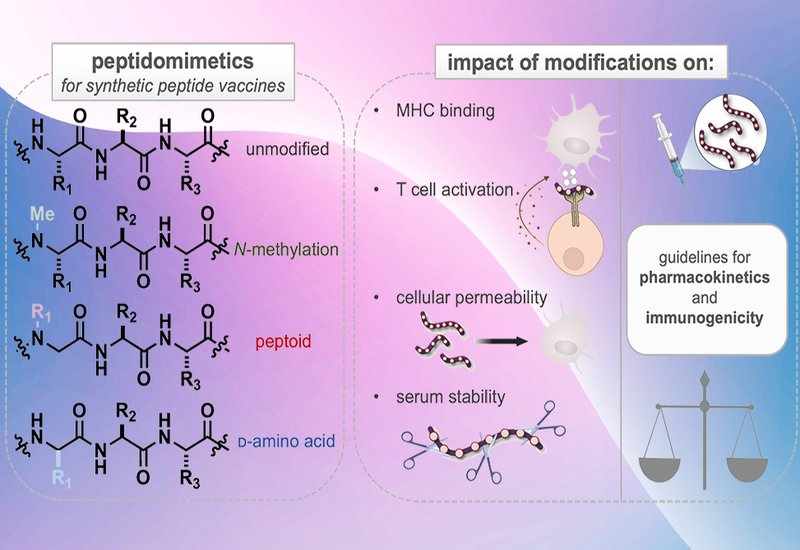
Peptide-based cancer vaccines aim to train the immune system against tumor-specific neoantigens, and a growing share of those targets comes from post-translational modifications rather than genetic mutations. These altered peptides can appear across different tumors, which makes them appealing targets for vaccines meant to reach many patients. Because mRNA and viral platforms can encode only genetically specified sequences, synthetic peptides offer the primary route to this class of antigen. Three obstacles limit their clinical use: rapid breakdown by serum proteases, poor entry into cells, and the exacting structural demands of binding to the major histocompatibility complex class I, MHC-I, and engaging the T cell receptor, TCR. Chemical modifications can improve stability and permeability, yet how they reshape antigen presentation and immune recognition has stayed largely uncharted.
Researchers in the Pires Group at the University of Virginia, published in ACS Chemical Biology, report a systematic test of how peptidomimetic modifications affect each step of antigen presentation. The team built a library around SIINFEKL, a well-characterized MHC-I epitope from the protein ovalbumin, and introduced three kinds of modification one residue at a time: backbone N-methylation, peptoid substitution, and inversion of stereochemistry to the D-amino acid. Four assays measured the results. An RMA-S cell assay reported peptide-MHC stability, a B3Z reporter assay tracked TCR-driven T cell activation, a mouse-serum incubation gauged protease resistance, and the group's CHAMP assay measured how much of each peptide reached the cytosol. Together the four readouts let the group separate effects on binding, recognition, durability, and delivery that are usually measured in isolation.
Tolerance to modification proved strongly position-dependent. The residues buried inside the MHC-I groove, isoleucine at position 2, phenylalanine at position 5, and leucine at position 8, rejected nearly every change in the RMA-S peptide-MHC stability assay, while solvent-exposed positions accepted them. This trend was reversed in the B3Z T cell activation assay. That stability pattern matched the epitope's crystal structure, in which the buried side chains anchor the peptide in the groove. Overall, backbone N-methylation was the best tolerated of the three approaches. Several N-methylated variants held their MHC-I binding and still activated T cells, and the same modification raised cellular accumulation at multiple sites, with stability, permeability, and immune recognition improving together. Peptoid and D-amino acid substitutions fared worse, removing T cell engagement at almost every position. A retro-inverso version of SIINFEKL, built to keep side chain geometry while reversing the backbone, failed to bind MHC-I at all, indicating that recognition rests on side chains and the native backbone jointly rather than on either alone.
The combinations proved nonadditive. A doubly modified peptide that paired a D-serine with an N-methylated phenylalanine kept strong T cell activation and gained serum stability, yet adding a third modification removed immune recognition entirely while deepening protease resistance. The work maps a narrow window in which chemical durability and immune function coexist, and it shows that individually tolerated modifications can cancel one another in combination. For groups designing peptidomimetic vaccines, it offers a way to weigh pharmacokinetic gains against the structural precision that MHC-I presentation and TCR engagement demand. The authors note that the findings rest on a single epitope and its matched receptor, leaving open how widely these rules apply across the antigen landscape that cancer immunotherapy must address.